Deep Time Walk
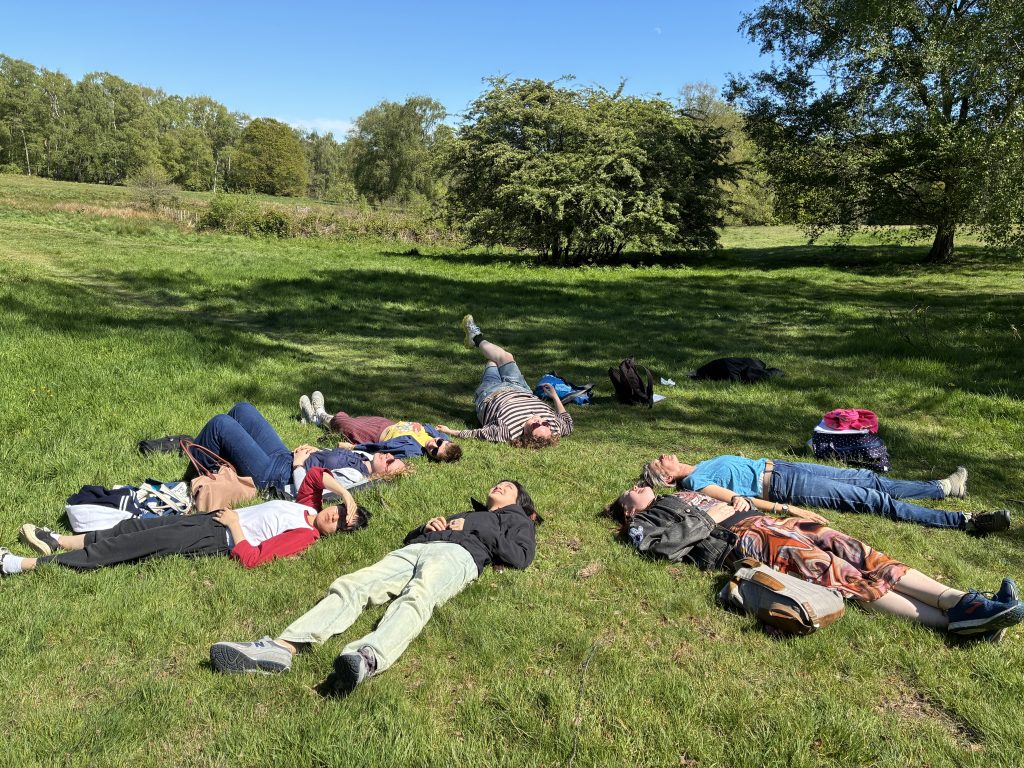
Yesterday, I joined a Deep Time Walk organized by the DPS team and spent a perfect day with a group of loooovely people. A Deep Time Walk is a 4.6km guided journey that brings Earth’s 4.6 billion-year history to life. Each meter you walk represents one million years of time. It is more than just a walk; it is an experiment for the head, heart, and body, allowing us to find our place within the wider living world through storytelling and reflection.
From Textbooks to Footsteps
I studied Environmental Science and Biology in high school, but walking the timeline felt completely different from reading a book. Every step represented hundreds of thousands, even millions of years. By lunchtime, with half the day already gone, we had only just reached the stage of the “Cambrian Explosion.” I felt a sense of urgency, knowing that dinosaurs, mammals, humans, agriculture, and the Industrial Revolution were still ahead, with only a few hours of walking left.
However, I had forgotten that the progression of time is not linear. Shortly after the rise of mammals, our tutor stopped and used her arm as a scale. In her less-than-one-meter arm span, humans appeared in the middle of her forearm, agriculture at her index finger, and the Industrial Revolution sat right at the very tip of her fingernail.
Rejecting Anthropocentrism
I was deeply shaken. Numbers in a textbook can never make you feel how tiny human history is compared to the Earth’s. We walked 4.6 kilometers, yet the entire history of human civilization covered less than 30 centimeters. This scale instantly shatters “anthropocentrism.” Humans are insignificant in the grand scale of ecology and history. What right do we have to think of ourselves as the masters of the Earth? This perspective gave me a more reverent understanding of “sustainability”: environmental protection is not about “saving the Earth”—it is about saving the fragile space that allows humans to exist.
The Barrier Between Idealism and Reality
We also discussed a very practical topic: the only reason we can sit here and discuss ecology and the future is that we are receiving a higher education. In the real world, so many people are struggling just to meet their basic needs for food and shelter. When a person cannot even guarantee their basic survival and freedom, they have no energy left to care about the environment.
This reminds me of a realization from my recent internship: there is a massive barrier between idealism and reality. Without financial support from parents, it is incredibly difficult to make a living by pursuing the ideals or causes we believe in. Concepts like sustainability and environmentalism are often a form of discourse that can only be held by those with a certain economic foundation.
An Unpredictable Future
Finally, I had a deep realization: the future is completely unpredictable. The bacterial ancestors at the dawn of the Earth could never have imagined that humans would appear billions of years later. Since the future has no fixed direction, all we can do is enjoy and cherish every present moment. We shouldn’t be overly anxious about a future that hasn’t happened yet, because while everything is unpredictable, it is also full of opportunity.
Leave a Reply